
Key takeaways
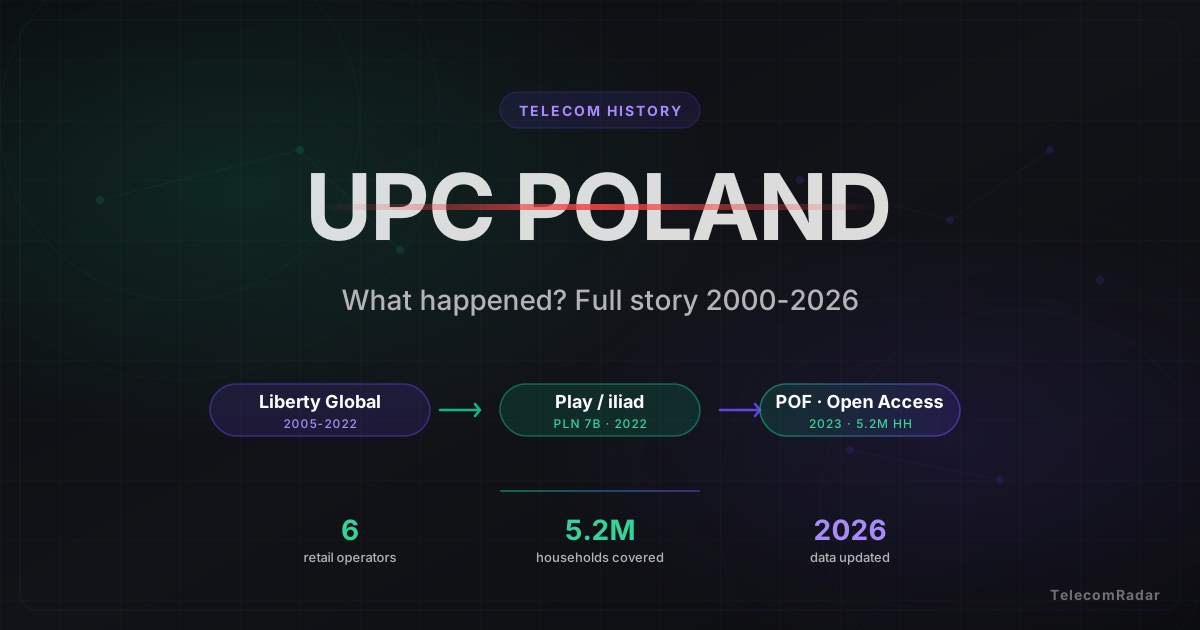
- •The UPC brand vanished from Poland on 31 August 2023: UPC Polska sp. z o.o. was removed from the National Court Register and absorbed by P4 sp. z o.o. (Play operator, owned by the French iliad group). Its customers are now Play customers.
- •Play bought UPC for PLN 7B (USD 1.8B), the deal was signed on 22 September 2021 and closed on 1 April 2022 after the European Commission's approval. Crucially: the decision belonged exclusively to the EC, not Poland's UOKiK.
- •The biggest plot twist: Play stopped being the sole owner of the network just a year later. In March 2023 it sold 50% of UPC's cable infrastructure to the InfraVia fund for PLN 1.775B, creating Polski Światłowód Otwarty (POF), a wholesale operator.
- •What does this mean for you? In an apartment on the former UPC network you can today choose internet from 6 nationwide operators (Play, T-Mobile, Netia, Plus, Orange, Vectra) plus around 30 regional ones, all of them use the same POF network.
Check coverage at address
Open tool →If you remember the UPC logo on the modem in your living room, the mailings offering 1 Gb/s, or invoices stamped "Liberty Global", that wasn't a dream. UPC was the second-largest cable internet operator in Poland, serving 1.5 million customers in 152 cities. And then it disappeared. Almost, because the network is alive, just under a different banner and with a completely different business model.
This guide explains what happened to UPC, what happened to your contract (if you had one), who the mysterious POF mentioned in the news is, and, most importantly, what options you have today in an apartment on the former UPC network. Data verified by us against official sources in May 2026.
Where did UPC come from? A short history 1989-2021
The network that eventually became UPC Polska originated in the late 1980s, it was built by Polska Telewizja Kablowa (PTK) operating since 1989. At its peak, PTK served around 1.7 million households in Warsaw, Kraków, the Tri-City, Katowice, Lublin, Szczecin and Kielce. PTK was owned by the American company @Entertainment, Inc. listed on NASDAQ.
In June 1999 the Amsterdam-based United Pan-Europe Communications (UPC) bought all of @Entertainment. A year later, in October 2000, UPC Polska sp. z o.o. was formally established. The common UPC brand covered all cable networks in Poland by 2007.
In 2005, UPC at the European level came under the control of Liberty Global, the American-British telecoms conglomerate headquartered in London and Denver, listed on NASDAQ under tickers LBTYA/LBTYK. Liberty Global owned UPC Polska for the next 17 years.
Aster: acquiring a competitor for PLN 2.4B (2010-2012)
A pivotal moment in Polish cable market history was UPC's acquisition of another large operator, Aster Polska. On 6 December 2010 Liberty Global signed a deal to buy 100% of Aster from the Mid Europa Partners fund. Price: PLN 870M plus assumed debt of ~PLN 1.53B, totalling roughly PLN 2.4 billion.
On 5 September 2011 UOKiK (decision DKK-101/11) conditionally approved the merger, UPC had to divest parts of Aster's network in Warsaw and Kraków where it overlapped with UPC's existing network. The deal closed on 2 January 2012. In 2012 UOKiK additionally fined UPC PLN 775,000 for withholding material information in the proceedings.
UPC's peak: 1.5 million customers (June 2021)
← swipe to see more →
In the background, in July 2019 UPC launched mobile services (MVNO on the Play network), which today sounds like a preview of what would happen 2 years later.
The sale of UPC to Play: PLN 7 billion (2021-2022)
On 22 September 2021 Liberty Global announced the largest transaction on the Polish telecoms market of that decade. UPC Poland Holding B.V. (a Liberty Global subsidiary) was selling 100% of UPC Polska to P4 sp. z o.o., the operator of the Play network, owned by the French iliad group.
Price: PLN 7.0B (around USD 1.8B). iliad's initial offer was PLN 7.3B, but during negotiations the price was reduced by PLN 300M. After paying off UPC's debt, Liberty Global was set to net around USD 600M.
European Commission approval: Case M.10515 (10 March 2022)
Here comes a legal curiosity rarely discussed: the merger approval was issued solely by the European Commission, NOT by Poland's UOKiK.
Why? Because the combined turnover of both companies exceeded the EU thresholds set out in Council Regulation (EC) 139/2004 on the control of concentrations. Under EU law, once that threshold is crossed, jurisdiction belongs exclusively to the EC, UOKiK no longer has a say on the merger itself (although it can of course intervene in consumer matters, which has since happened many times).
ℹ️ Info
Often confused: UOKiK did NOT issue any decision on the UPC-Play merger. All subsequent UOKiK fines against UPC/Play (there were several, described below) concern consumer protection, not merger clearance. These are two different legal regimes.
The European Commission ran the case under reference Case M.10515, Iliad/UPC Polska. The notification was filed on 3 February 2022, the clearance decision came on 10 March 2022, under Phase I (simplified procedure), unconditionally. The EC concluded that the transaction "does not raise serious doubts as to its compatibility with the internal market" (Art. 6(1)(b) of Regulation 139/2004). Public documents available in the EUR-Lex database (CELEX:52022M10515).
No structural or behavioural remedies: the EC found that Play had practically no fixed-line operations (mainly MVNO and resale), so there were no significant overlapping horizontal markets.
Deal closing: 1 April 2022. P4 became the 100% owner of UPC Polska.
The formal end of the UPC brand: 31 August 2023
For another year UPC Polska sp. z o.o. operated as a separate company within the iliad group. Customers received letters on UPC-branded paper, but IT platforms, billing back-end and CRM gradually migrated to Play's systems.
Formal absorption of the company took place on 31 August 2023, UPC Polska sp. z o.o. was struck off the National Court Register, and all assets, liabilities and contracts passed to P4 sp. z o.o. under the universal succession mechanism (Art. 492 § 1(1) of the Polish Commercial Companies Code). UPC's balance sheet as of 31 May 2023 showed assets of PLN 1.876B and liabilities of PLN 844M.
From 1 September 2023 P4 sp. z o.o. has been the formal telecoms service provider and personal data controller for former UPC customers, as their official correspondence informed them.
What is POF and why did Play step back from being the network owner?
Here we reach the most surprising part of the story, the part most Polish media articles don't explain properly.
Play bought UPC in April 2022 for PLN 7B. And just a year later it stopped being the sole owner of the network.
Doesn't sound logical? It's actually a very deliberate business move that shifted the balance of power on Poland's fixed-line internet market. Let's break it down step by step.
How POF came to be: timeline 2022-2023
← swipe to see more →
POF structure: 50/50 P4 and InfraVia, zero state ownership
Polski Światłowód Otwarty (Polish Open Fiber) is a company in which:
- 50% of shares are held by P4 sp. z o.o. (iliad group)
- 50% of shares are held by Plug Finco Sàrl (an investment vehicle of InfraVia V Invest Sàrl, managed by InfraVia Capital Partners, a French infrastructure fund)
Despite the name "Polish Open Fiber", no Polish public-sector entity holds any shares in the company. This is not a project of PFR, KGHM or the State Treasury. Contrary to what is sometimes said, it is a private joint venture of two Western groups.
Why did Play do it? The business logic behind the split
From iliad/Play's perspective the decision to carve the network into a JV had four concrete arguments:
- Cash: InfraVia paid Play PLN 1.775B in cash for 50% of the shares. That's a return of nearly 25% of the capital Play had spent a year earlier buying the whole UPC.
- Modernisation costs: UPC's cable network was largely HFC DOCSIS (cable). To compete with Orange and T-Mobile, it had to be upgraded to FTTH (fibre to the home), which costs billions. POF arranged PLN 5.1B of external financing (10 banks + EIB, later increased to PLN 5.8B), a burden Play didn't have to carry alone.
- Multi-tenant model > vertical integration: when a network serves many retail operators at once, infrastructure utilisation (and so ROI) is higher than when only one operator (Play) sells services on it. Every new POF retail client (T-Mobile, Netia, etc.) increases revenue from the same network.
- Less regulatory pressure: the EU and Poland's regulator (UKE) increasingly favour open networks. Vertically integrated operators (network owner + dominant retail arm) are more often the subject of proceedings. The wholesale-only model lifts that shadow.
ℹ️ Info
A simple analogy: imagine the A1 motorway. Previously the same entity was its owner and its only carrier (like UPC: cable owner + only service seller). Now the motorway (POF) is a separate entity, and various transport companies drive on it (Play, T-Mobile, Netia, Plus, Orange, Vectra). Each pays POF for the journey. That's open access, and that's what the name is about.
POF in 2026: scale, results and ambitious plans
After three years of operation POF is now the largest open access network in Poland and one of the largest infrastructure projects in the CEE region.
← swipe to see more →
Elsat: taking over Vectra's network (April 2026)
One of POF's most recent moves is the acquisition of Elsat from the Vectra Group. Elsat is a Vectra subsidiary holding local cable infrastructure covering around 2.3 million households.
- 6 June 2025: preliminary agreement POF + Vectra
- November 2025: UOKiK clearance (two-phase proceeding due to the scale)
- 30 April 2026: closing of the transaction
For POF this move means +670,000 new households in coverage (after excluding areas where POF already had its own network). The Elsat network covers more than 80 Polish cities, mainly those where Vectra was traditionally strong. Technical integration is expected to be completed in 2027.
In return Vectra retains long-term wholesale access to that network and remains an active retail operator on the market.
What happened to UPC customers after Play's takeover?
From the customer's perspective the entire operation went automatically. Customers did not have to and could not refuse moving to Play, in Polish law, universal succession (Art. 492 § 1(1) of the Commercial Companies Code) means that when one company is absorbed by another, all its contracts automatically pass to the legal successor.
UPC → Play customer migration (timeline 2022-2025)
← swipe to see more →
⚠️ Warning
DNS scandal, check your router: in October 2024 the Niebezpiecznik.pl portal revealed that Compal routers originating from UPC, after a remote firmware update by Play, were configured with the DNS suffix `utopia.net`, an address flagged by antivirus software as malicious. The consequences were speed drops (from 1 Gb/s to 170 Mb/s) and potential DNS traffic interception. Play officially confirmed the problem. If you're still using an old UPC router, it's worth checking the DNS settings or asking Play for a device swap.
UOKiK fines against UPC and Play: over PLN 40M in sanctions
This is a section most articles stay silent about, yet it shows the scale of problems with UPC's practices in recent years. The total of fines and refunds imposed by UOKiK and upheld by the Supreme Court exceeds PLN 40M.
Below are 5 key UOKiK and Supreme Court rulings against UPC (and after the absorption, against Play as its legal successor):
← swipe to see more →
ℹ️ Info
What this meant for customers in practice. Under the above UOKiK and Supreme Court rulings UPC subscribers (after the transfer, Play subscribers) could for a while claim refunds:
- Customers covered by the "More benefits for you" programme (decision RBG-3/2024) received refunds of up to PLN 72 automatically, Play was obliged to refund everyone as part of executing the UOKiK decision.
- Some people who paid excessive early-termination penalties under decision DOZIK 13/2022 could request a re-calculation within 3 years of the charge.
- Claims arising from the 2015-2016 price hikes (decision RGG-10/2019, confirmed by the Supreme Court in October 2024) are today mostly time-barred under the 3-year limitation period in Art. 118 of the Polish Civil Code, even though the UOKiK decision formally still binds Play.
UOKiK administrative decisions remain a historical record of practices used by UPC, but an individual claim today rarely leads to a refund, the operator can raise the limitation defence.
Your rights after the UPC → Play transfer (PKE 2024)
On 10 November 2024 the new Electronic Communications Law (PKE), Act of 12 July 2024 (Journal of Laws 2024 item 1221), entered into force in Poland. It replaced the Telecommunications Law that had been in force for almost 20 years. For former UPC customers (and all other Play customers) it introduces several key protections.
The most important PKE articles for consumers
← swipe to see more →
Can you terminate the contract for free after the UPC → Play transfer?
This is the most frequently asked question and the answer is unfortunately: NO, not just because of the operator's name change.
The name change (UPC → Play) happened through universal succession, which Polish law classifies as a non-modifying change of provider. The mere fact that your operator is now called Play, not UPC, does not give you the right to terminate the contract without consequences. This position is confirmed both in Play's correspondence to customers and has not been challenged by UKE/UOKiK.
BUT, read Play's correspondence carefully:
- If Play changes the terms of your contract (e.g. removes TV channels outside must-carry, raises the price, changes the technology) → you are entitled to termination without penalty under Art. 306 PKE
- In December 2025 a portion of UPC/Play customers exercised this right after changes to the TV packages
- If Play delays porting your number or hasn't activated the service yet → no fees (Art. 304 §2)
Contract termination generator: step-by-step guide
Check your rights and generate a valid termination notice for Play (or any other operator). All legal bases from PKE 2024, ready-made PDF with up-to-date content.
What does Play offer today on the former UPC network (May 2026)?
Current Play packages on POF infrastructure (the former UPC footprint) rely on mixed technology, mostly HFC DOCSIS 3.1, and where POF has completed the upgrade, XGS-PON (fibre to the home, up to 8 Gb/s). The exact technology available depends on the address.
← swipe to see more →
⚠️ Warning
Check the post-promo price before signing. In the TelecomRadar database all Play packages on POF have a constant difference of +PLN 10/mo between the contract price and the full rate (e.g. 300 Mb/s: 65 → 75 PLN, 1 Gb/s: 85 → 95 PLN, 8 Gb/s: 105 → 115 PLN).
Operator contracts also typically contain an inflation-indexation (CPI) clause which can raise the rate each year. PKE 2024 Art. 306 gives you the right to terminate without an equalisation fee if the operator unilaterally changes the price mid-contract.
Alternatives to Play: 4 other operators on the POF network
And here we get to the heart of this article, on the former UPC network (now POF) 5 nationwide retail operators compete: Play, T-Mobile, Netia, Plus and Orange. You're not locked into Play, you can choose any operator with a POF wholesale agreement that serves your building.
- T-Mobile: Magenta Home with mesh router, integration with T-Mobile mobile services
- Netia: strong internet + TV bundles, historically good consumer reputation
- Plus (Polkomtel), integration with Cyfrowy Polsat services (Polsat Box, premium channels)
- Orange Polska: Funbox 7 (Wi-Fi 6E), bundles with Orange TV
Check coverage at address
Open tool →Enter your address above and we'll check all the operators available at your location. We'll show not only Play but every alternative using the same POF network plus the other wholesale networks (Orange, Światłowód Inwestycje, Fiberhost, Tauron).
Competition for POF: is this a monopoly?
Despite worries about consolidation (UPC + Vectra/Elsat → POF), Poland's fixed-line internet market remains plural. The main nationwide competitors of POF are:
- Orange Polska: its own FTTH network passed 10.1M HH (Q1 2026), Poland's largest fibre footprint. 1.76M active fibre customers.
- Światłowód Inwestycje: a JV of Orange and APG (TPG), another open FTTH network
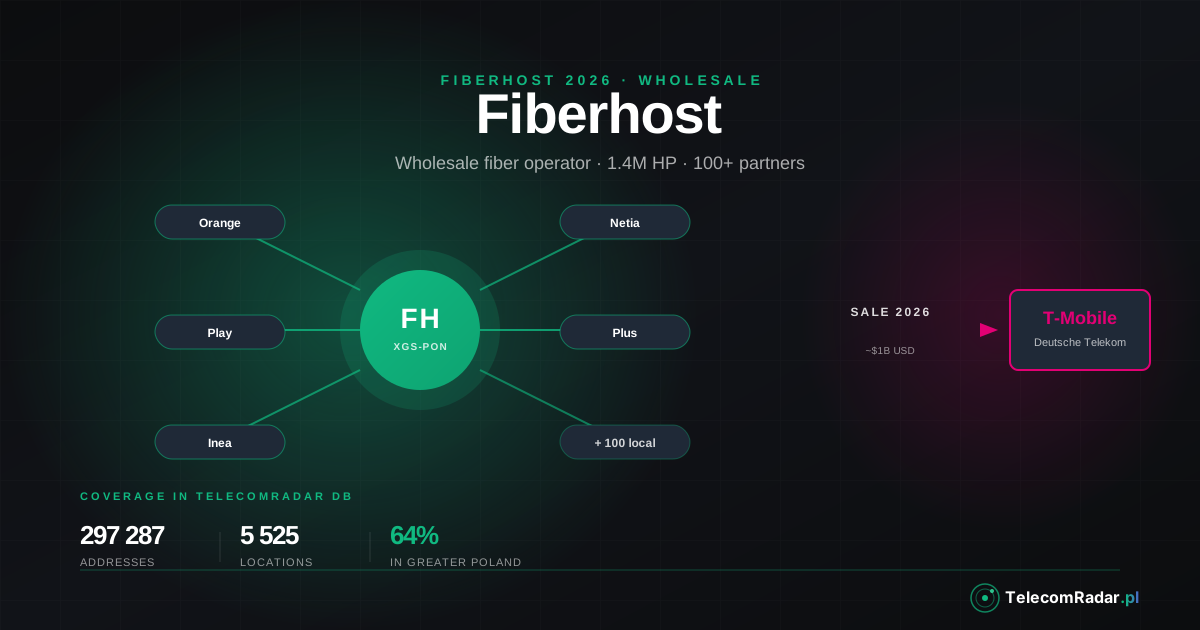
- Fiberhost: a large regional wholesale operator (sells to Netia, Plus, T-Mobile)
- Nexera: a wholesale-only network built with POPC funding (Operational Programme Digital Poland)
- Tauron: an energy operator building FTTH mostly in southern Poland
- Inea (Wielkopolska), Toya (Łódź), strong regional networks
Poland therefore has not one but several parallel open access models, which is unique in Europe. For the user this means: in most cities you have a choice from several different networks, and within each, from several different retail operators.
All wholesale networks in Poland: full list
Full overview of the 7 wholesale networks covering Poland: Orange, POF, Światłowód Inwestycje, Fiberhost, Nexera, Tauron, Vectra. Weekly data, current coverage per city.
Do UPC's domains still work? Status in 2026
← swipe to see more →
FAQ: 10 most frequent questions about UPC in Poland
Does UPC still exist in Poland?▾
No. The UPC Polska brand was retired on 31 August 2023 when UPC Polska sp. z o.o. was legally absorbed by P4 sp. z o.o. (Play operator, owned by the French iliad group). Former UPC customers are now Play customers.
Who bought UPC Polska and when?▾
P4 sp. z o.o. (Play operator, iliad group), agreement signed on 22 September 2021, transaction closed on 1 April 2022 after the European Commission's approval (10 March 2022, Case M.10515). Price: PLN 7.0B (about USD 1.8B).
Could a UPC customer terminate their contract after the Play takeover?▾
Not without financial consequences. The mere change of provider name does not entitle you to free contract termination. Termination during the contract period still triggered the early-termination penalty (proportional return of promotional discounts). The exception is when Play unilaterally changes the contract terms, then Art. 306 PKE 2024 grants termination without penalty.
What is Polski Światłowód Otwarty (POF)?▾
POF is a company in which 50% is held by the iliad group (through P4) and 50% by the InfraVia Capital Partners fund (through Plug Finco Sàrl). It operates strictly as a wholesale broadband access provider, offering equal access terms to all retail operators. As of May 2026 the POF network covers 5.2 million households. Despite the name there is no public-sector shareholding, it's a private joint venture.
Does Play face competition on the former UPC network?▾
Yes, Play is the largest but not the only retail operator on POF infrastructure. T-Mobile, Plus, Netia, Orange Polska and Vectra (joined in 2026 as the last of the big-6) also offer services on the same network, alongside around 30 local ISPs.
What happened to the upc.pl website?▾
Since 2023 upc.pl has been redirecting to play.pl. The "Moje UPC" portal was shut down in February 2024, replaced by "Moje Usługi". UPC Mail (upcpoczta.pl) was shut down on 30 September 2024, customers had to export their mail beforehand.
Do my old UPC decoders still work?▾
Partially. Since 28 February 2025 the old Mediaboxes (Pace 7111) no longer have VOD access but still receive linear channels. 4K Box TV decoders require mandatory replacement with PLAY BOX TV (Android TV), the process started in November 2024, the swap is free of charge (InPost locker or Play store). Some Horizon decoders (DVB-C) are still supported in selected network areas.
Could UPC customers recover overpaid charges?▾
Within the validity of each ruling, yes, but for a limited time.
Refunds under the "More benefits for you" programme (decision RBG-3/2024) were processed automatically, Play refunded up to PLN 72 to customers covered by the programme. Excessive early-termination penalties from decision DOZIK 13/2022 could be claimed back from the operator within 3 years of the charge.
Claims related to the 2015-2016 price hikes are today mostly time-barred under Art. 118 of the Civil Code (3-year limitation), despite the Supreme Court's October 2024 ruling obliging Play to comply with the UOKiK decision. So in practice this particular refund is hard to obtain individually today.
Was the UPC-Play merger approval conditional?▾
No. The European Commission cleared case M.10515 unconditionally in Phase I (Art. 6(1)(b) of Regulation 139/2004). Poland's UOKiK did not issue a separate concentration decision, jurisdiction lay exclusively with the EC due to the EU turnover thresholds.
Does Art. 304 PKE 2024 protect customers after the UPC → Play transfer?▾
Yes. Since 10 November 2024 Play (as the legal successor of UPC) operates under the PKE 2024 regime. The early-termination penalty cannot exceed the remaining subscription fees during the contract period plus unpaid instalments for promotional devices. This is a significant improvement compared to the practices of 2015-2022, for which UPC received a PLN 12.58M fine.
Summary: what's worth remembering
The story of UPC in Poland is an example of a business-model transformation whose key consequences most consumers haven't noticed. The brand disappeared, but the infrastructure opened up:
- 2000-2022, UPC as a vertically integrated operator: network owner + only seller of services on that network.
- April 2022, Play buys UPC for PLN 7B, the brand is still alive.
- March 2023, Play sells 50% of the network to InfraVia for PLN 1.775B. POF is created, a wholesale-only operator.
- August 2023, formal end of the UPC brand. Customers become Play customers.
- 2023-2026, on the former UPC network 6 nationwide + ~30 regional retail operators compete.
- 2026, POF takes over the Elsat network from Vectra, coverage grows to 5.2M HH.
For the user: you have more options today than ever before. If you live on the former UPC network, check all operators (not only Play), compare the post-promo prices (not only the current ones), and remember your rights under PKE 2024.
Find out which operators serve your address, compare prices, speeds and bundles of all available offers in one place.
Compare offers for your address→Want to be first to know about changes on Poland's internet market?
Sign up for the newsletter. Each month we analyse mergers, price hikes, new offers and UOKiK decisions. No spam, only the most important things from the telecoms market.
Sources and verification
Every fact in this article was verified against at least two independent sources in May 2026. Main sources:
- European Commission: Case M.10515 Iliad/UPC Polska (EUR-Lex CELEX:52022M10515)
- iliad / P4 / Play: official statements (biuroprasowe.play.pl, globenewswire.com)
- InfraVia Capital Partners: portfolio page (infraviacapital.com/companies/polski-swiatlovod-otwarty/)
- Polski Światłowód Otwarty: official site (swiatlowodotwarty.pl), interview with CEO Ignacio Irurita in "Parkiet" (May 2026)
- UOKiK: decisions DOZIK 13/2022, RBG-3/2024, RGG-10/2019
- Supreme Court: judgment October 2024 (case P4 vs UOKiK, RGG-10/2019)
- Industry media: Telepolis, rp.pl/Parkiet, Wirtualne Media, Inwestycje.pl, CRN, Niebezpiecznik (DNS hijacking)
- Polish Wikipedia: articles on UPC Polska and POF (as cross-reference)
See also
Play internet: offers & coverage
Check current Play offers and coverage at your address.
Compare internet offers at your address
Enter your address to see available operators and real prices.
Was this article helpful?
Try it in our tools
Related articles
Comments
No comments yet. Be the first!